
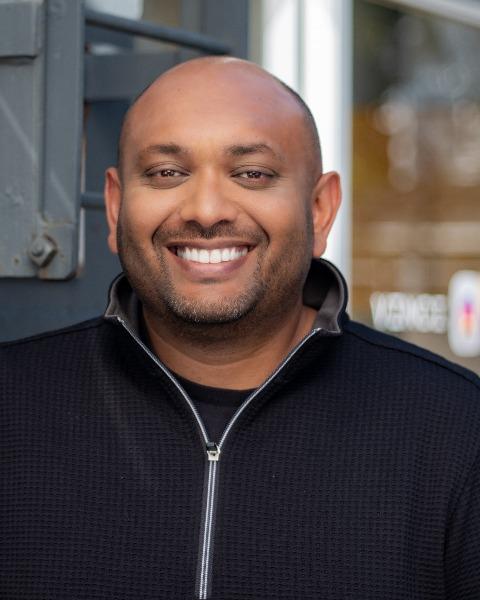
Hardik Kabaria
Co-founder and CEO
Vinci
About Hardik
Hardik Kabaria believes the next great frontier of artificial intelligence is not language, images, or code.
It is physics.
Kabaria is the founder and CEO of Vinci, a frontier lab building the systems required to make physical reality continuously computable. Unlike traditional research labs, Vinci is not operating on a multi-year path to relevance—its systems are already embedded inside production engineering workflows, running on flagship programs where physical accuracy directly impacts cost, yield, and performance.
His work is grounded in a simple observation: while software has become programmable, physics has remained episodic—accessed through discrete simulations, approximations, and human-mediated workflows.
Under Kabaria’s leadership, Vinci is building the first system in what is emerging as continuous physics infrastructure—where physics is no longer simulated, but continuously computed. At its core is a physics foundation model—a deterministic, solver-grounded system capable of reasoning directly over physical systems without reliance on customer data.
This represents a structural shift in how physical systems are designed, understood and operated. Rather than running simulations as isolated events, engineers operate inside a persistent system that computes physical behavior directly on manufacturing geometry with solver-grade determinism. Entire classes of approximation, including meshing and model reduction, are removed. Physics becomes an always-available layer of computation embedded within the engineering process itself.
The system is expanding beyond its initial semiconductor wedge—thermal conduction and thermo-mechanical behavior—into a broader set of physical domains, including fluid dynamics, electromagnetics, and radiation. The direction is not the addition of new solvers, but the unification of physical reasoning into a single, continuously computable system.
Kabaria’s work sits at the intersection of computational physics, geometry, and large-scale systems design. His focus is not on accelerating existing tools, but on replacing the underlying interaction model between engineers and physical systems.
Before founding Vinci, Kabaria was Vice President of Software at Carbon, where he led the development of computational systems that powered one of the world’s most advanced digital manufacturing platforms. Earlier in his career, he worked on core challenges in engineering computation, including automated mesh generation for complex geometries—experience that informed his view of the structural limits of simulation-based approaches.
He earned his Ph.D. in Mechanical Engineering from Stanford University, where his research focused on scaling computational methods for complex physical systems.
- Track
- World Models
- Industry
- Software
- Job Function
- Management
- Company Size
- 51-100 employees